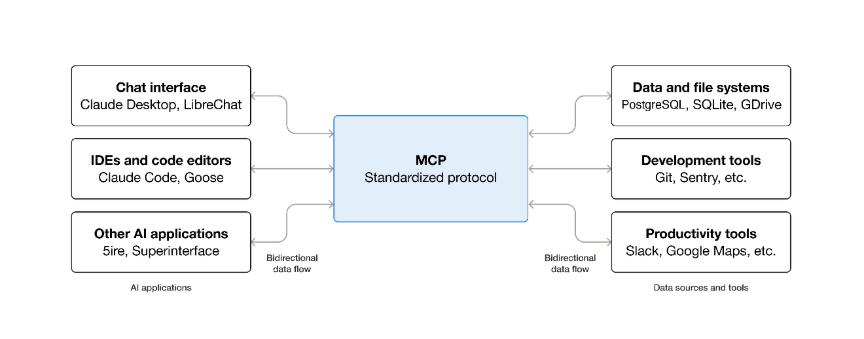
In today’s AI-powered landscape, software systems must connect models, tools, and data sources seamlessly. Traditional APIs or microservices alone aren’t enough. That’s where MCP (Model Context Protocol) comes in.
What Is MCP?
The Model Context Protocol (MCP) is an open-source standard that allows AI applications to seamlessly connect with external systems.
Through MCP, AI models such as ChatGPT or Claude can integrate with data sources (like local files or databases), tools (such as search engines or calculators), and workflows (including specialized prompts). This connection enables them to access essential information and execute tasks more effectively.

What can MCP enable?
- AI agents can access tools like Google Calendar and Notion, allowing them to function as truly personalized assistants.
- Development tools such as Claude Code can generate complete web applications directly from Figma designs.
- Enterprise chatbots can connect to multiple organizational databases, enabling users to query and analyze data through natural conversation.
- AI models can even design 3D objects in Blender and send them directly to a 3D printer for production.
MCP Architecture Overview
- Model (LLM or AI Engine)
- The reasoning and generation component.
- Interacts through MCP-defined requests/responses.
- Context Server / MCP Server
- Acts as a bridge between the model and external systems.
- Provides structured data, tools, and memory context.
- Client / Application Layer
- The end-user application (web, mobile, chat interface, etc.)
- Uses MCP to exchange information securely and efficiently.
Flow Example:
- The application sends a request (via MCP) to the model.
- The model asks the MCP server for relevant data or tools.
- The MCP server fetches real data (from SQL, APIs, etc.) and returns it.
- The model uses this context to generate accurate, real-time responses.
Why Software Houses Should Adopt MCP ?
- Integration Speed: Easily connect AI models to clients’ internal systems or databases.
- Consistency: Use one standard to manage multiple tools, models, or APIs.
- Scalability: Scale AI-driven features across products without rewriting integrations.
- Security: Control and log every model interaction (important for enterprise clients).
- Innovation: Faster R&D cycles since developers focus on features, not repetitive integration work.
Conclusion
MCP represents a major step forward in building context-driven, intelligent software ecosystems. By integrating MCP, software houses can deliver secure, scalable, and adaptive AI solutions that leverage real-world data.
At Intixel, we view MCP as a foundational architecture for the next generation of enterprise AI systems. We use the Model Context Protocol (MCP) to build intelligent, AI-driven software systems. MCP allows AI models to connect seamlessly with external data sources, tools, and workflows, enabling real-time, context-aware responses. Our architecture includes the AI model for reasoning and generation, an MCP server to bridge the model with data and tools, and the client layer where users interact with the system. By adopting MCP, we deliver scalable, secure, and adaptive AI solutions that integrate with enterprise databases, applications, and specialized tools, helping businesses innovate faster and provide smarter experiences for their users
References:
Model Context Protocol. (2024). Getting started with MCP. Retrieved October 30, 2025, from https://modelcontextprotocol.io/docs